

Tax payments are a rather thorny issue in the tax collection of any country, especially when it comes to new taxes, because there is no total certainty on the part of the population regarding the good or bad use that these revenues may be made by the government authorities.
However, the truth is that taxes are an essential part of the administration and budget of every country, since it is from these resources that the multiple public services that we use every day are generated.
Specifically, one of the taxes that can generate the most doubts among citizens is the property transfer tax and documented legal acts, since it is a complex tax that is in force in the laws of Spain.
The reason that this is a complex tax is that it is responsible not only for one type of tax but it can include the assessment of up to three different types of taxes, which present important differences from each other.
In this way, the general use of this law applies to these three scenarios from a fundamental basis, so that later, depending on the taxable event, the specific tax that corresponds to it is applied.
What is the Tax on Patrimonial Transmissions and Documented Legal Acts about?

This tax applies in cases where you buy some type of property , such as a house or a second-hand car , or also when you go to the notary to issue a deed.
Thus, in order to register the property in the Property Registry, or to register the change of ownership in the case of a car, we are asked to make the payment to the Autonomous Community of the so-called "ITP/AJD", better known as the Tax on Property Transfers and Documented Legal Acts.
In short, this is the tax that will be applied to different types of transactions related to the purchase and sale of various high-value tangible assets, such as the purchase of homes or real estate. This tax can also be applied to capital increases or the preparation of notarial deeds.
In this way, when paying this tax, it can be interpreted that it is being paid for the right and regulation on transaction processes and documentation in exchanges of high value goods. For example, to sell a home, this tax would have to be paid for the right that we are given to dispose of that property for the generation of an economic income.
Where is the ITP / AJD payment made?
In order to make the payment of the Property Transfer Tax and Documented Legal Acts , you must go to the Tax Office of the Autonomous Community where the tax is produced, within a period of about 30 days after the respective transaction has been carried out, or that action that justifies the issuance of this tax.
How is the payment of the ITP / AJD tax made?
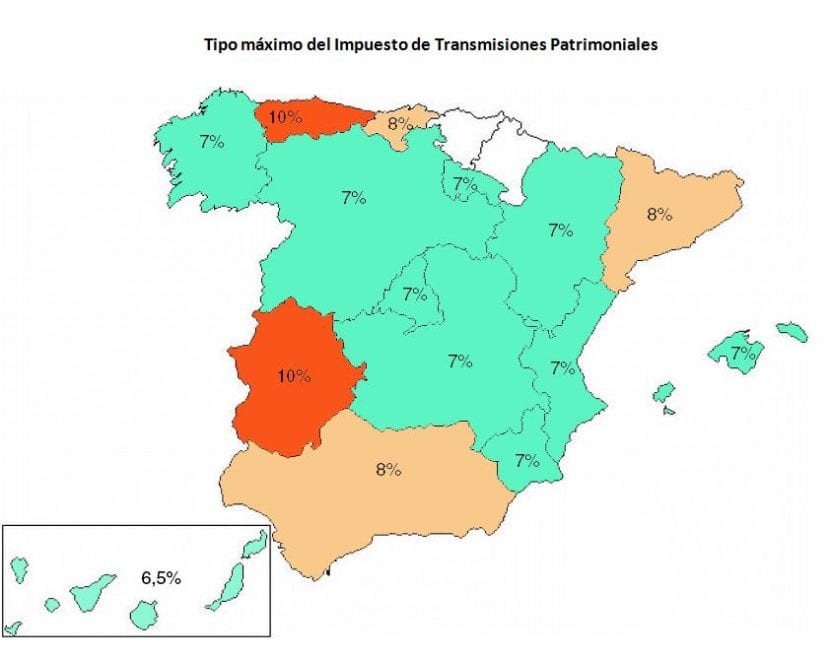
In order to make the corresponding payment of the Property Transfer Tax and Documented Legal Acts , it is necessary to provide either the National Identity Document (DNI) or the Tax Identification Code (CIF), as well as the first copy and a simple copy of the public deed and also the original document of the contract; a copy of this document will also be required in case the operation subject to consists of a private document, regarding the act by means of which the origin of the tax is given.
What are the classifications of the Tax on Patrimonial Transmissions and Documented Legal Acts?
Within this area we have the following three types of taxes:
- Costly asset transfers
- Documented legal acts
- Corporate operations.
Each one corresponds to a specific taxable event, so it is important to take into account the characteristics and elements in which one of these types of tax should be applied.
For example, in the case of onerous property transfers , it is one of the most common taxes in this classification, since it basically occurs when a person acquires a certain asset, which entails a respective payment obligation towards the person who sold said asset, that is, this tax levies all those operations that involve a transfer of assets between two individuals, such as those scenarios in which the purchase and sale of real estate is carried out or also in the case of the generation of usufructs or leases.
For corporate operations , we have, of course, a different situation, since these are used in the economic management of groups or companies whose purpose is some management in the use and distribution of capital, such as its increase or decrease, as well as the merger and/or dissolution of companies.
Finally, documented legal acts apply to deeds, notarial acts, and bills of exchange. Once we have a basic understanding of how each of these tax types is used, we can delve deeper into each one, analyzing their defining characteristics and elements, as well as the scenarios and circumstances in which they should be applied.
Costly asset transfers

Onerous property transfers, which as we saw earlier, are present for the purchase and sale of real estate or the establishment of real rights, leases, etc., contain three primary elements, which are the liable party, the taxable base and the tax rate.
The passive subject is the person in whose favor the real right is established, as well as the person who promotes the ownership proceedings or the notarial acts, among other functions.
The taxable base of the tax consists of the real value of the asset to be transferred or the right established.
The tax quota can be divided into three different levels:
- 6% in the case of the transfer of real estate or the transfer of real rights over these assets.
- 4% in the case of the transfer of movable property and livestock, as well as the respective constitution of real rights over them.
- 1% in the case of the constitution of collateral rights, pensions, bonds, loans and the assignment of credits.
Corporate Operations
Here, the taxpayer is the company, except in cases of capital reduction and dissolution, where the taxpayer will be the shareholders. The taxable base will be determined according to the following characteristics:
- The nominal amount of the constitution and capital increase plus the issue premiums.
- In the cases of spin-off and merger, the base will be the capital of the newly created entity or the capital increase in the absorbing company, plus the corresponding issue premiums.
- In the cases of capital decrease and issuance, the base will be determined by the real value of the assets and rights that have been delivered to the partners.
Here the tax rate will be 0.5% for all cases.
Documented legal acts

When this type of tax is levied, which as we saw applies to deeds, bills of exchange, notarial acts and testimonies, etc., the taxpayer will be the acquirer of the asset or right for the notarial documents.
The taxable base for the tax will usually be the declared value when dealing with first copies of public deeds concerning a sum of money or valuable asset. In the case of bills of exchange, the taxable base will be the amount drawn, while in cautionary notices, it will be the value of the right being guaranteed, published, or established.
Finally, the tax rate will be divided into two types of tax , which will be 0.5% for the first copies of deeds and notarial acts, but in the case of bills of exchange, the tax rate will be determined by the stamped effects, according to the scale determined by law.
Conclusions
There is no doubt that in the world of business and the buying and selling of properties of various kinds, it is not only advisable, but a priority, to have accurate legal and juridical information that provides us with both certainty and security regarding the various transaction processes we can carry out to acquire or sell properties, as well as when we generate the documentation that supports each of these procedures.
The tax on transfers and documented legal acts includes a broad legal margin for the government to legally recognize our purchases, capital management and/or generation of deeds and notarial documents.
By failing to pay this tax, we run a great risk of falling into very costly penalties, which would end up being much more expensive than what it would cost us to hire a lawyer to help us with the due process and payment of the lien. For this reason, it is also recommended to request a professional service regarding the legal details for the fulfillment of this obligation, because in the end it will yield multiple and substantial benefits, such as avoiding future penalties and providing us with certainty in the property and capital management that we carry out.
Table of Contents
- 1 What is the Tax on Patrimonial Transmissions and Documented Legal Acts about?
- 2 Where is the ITP / AJD payment made?
- 3 How is the payment of the ITP / AJD tax made?
- 4 What are the classifications of the Tax on Patrimonial Transmissions and Documented Legal Acts?
- 5 Costly asset transfers
- 6 Corporate Operations
- 7 Documented legal acts
- 8 Conclusions